Look here for slang, shorthand expressions, knicknames, and trivia related to the history of Seattle and the Pacific Northwest, including the the Battle in Seattle, the Denny Party, Chief Sealth, Doc Maynard, Hooverville, the Interurban, the Kalakala, Mercer's Maidens, Mother Damnable, the Mosquito Fleet, the Pig War, Princess Angeline, Profanity Hill, the Seattle Seven, Skid Road, the Wobblies, and more.
The Battle in Seattle: A descriptive term for the WTO protest brouhaha at the start of December, 1999. Variantly referred to as the Battle of Seattle, although that risks confusion with an earlier event of arguably greater importance (see next listing). For a running commentary and description of events on those days, see First-Hand Report on Events in Seattle.
The Battle of Seattle: A one-day battle between the residents of Seattle and hostile Indians who'd come as far as eastern Washington to attack the infant burg. Part of a larger Indian uprising called the Yakima Indian War. A phrase sometimes used to describe the WTO protest demonstrations in Seattle, which should more properly be termed as the Battle in Seattle. For more information, see Native Americans attack Seattle on January 26, 1856.
The Boeing Bust: Period at the start of the 70's when Boeing, the major employer for the Seattle area, laid off two-thirds of its workers as demand for airplanes collapsed, creating near-Depression conditions in Seattle. A famous billboard of the time read: "Will the last person to leave Seattle please turn off the lights." Some fear, but others pray for, the next bust. Part of what keeps the Seattle-area, with its quintessential boom-and-bust economy, what it is. Good for sluicing a good proportion of those expatriate Californians back down I-5, in other words. Expatriate New Yorkers, however, perhaps due to their clinging to Seattle's many hills, it seems are more likely to stick it out. See: 'Turn out the lights': Remembering the Boeing bust billboard
The Bostons: The term by which Northwest Coast Indians referred to white Americans. An American built lodging was called a "Boston house", as opposed to the communal lodges used by the natives. The term likely traced back to early sea-otter traders from New England, beginning in the 1790s. British, on the other hand, were referred to as "King George men".
Brooklyn: The original name of what became the University District. The name originates from the area being across the water (Lake Union) from what was Seattle proper ("New York Alki") at the time. I'm not sure when the name was changed, but it had to be after the U relocated there (following the 1909 Alaska-Yukon Exposition).
The Bulge: A rather unusual feature of the original Mercer Island Floating Bridge, officially named the Lacy B. Murrow Floating Bridge (the floating bridge that sank). About mid-span, the two east and west traffic lanes split into a "bulge" -- sort of like this, ===O=== -- originally designed to make it easier to open the bridge to boat traffic, but which proved to be a real menace to less than aware drivers. At least one drunk, I recall, and there may have been others, met an untimely end when his car plunged into the waiting maw at the center of the Bulge and sank to the bottom of the lake.
Chief Seattle: A leading member of the Duwamish tribe, mistakenly thought to be a chief, after whom Seattle was named. His name has also been rendered as "Sealth" (supposedly pronounced See-alth), although even that misses the mark - the Southern Lushootseed dialect spoken by him includes sounds and utterances not included in English. His own Duwamish tribe renders his name as Si'ahl. He was a tyee, which is often translated as "chief," but more accurately refers to a V.I.P., or dignitary, and thus due additional respect or veneration, but not to someone who had any particular authority. War leaders were elected, when needed. The first report of Chief Sealth comes from William Fraser Tolmie of the Hudson's Bay Company who was one of the first explorers of the Puget Sound basin -- he referred to him as "Silah...a brawny Soquamish with a Roman contenance & black curly hair, the handsomest Indian I have seen." There are two prophetic speeches extant that are credited to Chief Sealth, but it is highly doubtful that the words in either were ever spoken by him. See Chief Si'ahl and His Family.
The Columbus Day Storm: The biggest storm to hit around here, in living memory anyway. Heap big blow. It happened on Columbus Day (October 12th), 1962, I believe.
The Commons: The Seattle Commons, which was an ambitious plan to turn a large swath of real estate between south Lake Union and downtown into a park (or "commons") surrounded by upscale housing and development. The idea was that tax revenues from the development around the place would pay for buying up all of the real estate for the park proper. Paul Allen was a big supporter, if I recall. Was really a Seattle-yuppie pipe dream, animated by our desire to have our own personal "Central Park," ala New York. The local businesses that would be displaced, serenely overlooked in the formation of this plan, howled like stuck pigs. It also gradually sank in that the real estate surrounding the planned Commons lacked an essential Seattle attribute, a water-view, and thus would be unlikely to command enough of a yuppie-premium to pay for the Commons. When it was put on the ballot, the voters crushed it, twice. Ironically, however, without the failed Commons drive, the current mad development in the area, ramrodded by Paul Allen Jeff Bezos, might never have happened.
The Commonweal Army: The Commonweal Army of Christ, a protest march on Washington, D.C., organized in 1894, as "a petition with boots on," by Jacob S. Coxey and Carl Browne, to protest the depression-like economic conditions and unemployment that plagued the NW at the time, demanding passage of a Good Roads Bill and a Non-Interest-Bearing Bond Bill. When the first contingent, or battalion, of the army set out from Massilon on Easter Sunday 1894, with "General" Coxey at their head (or in their tow, since he road in a piano box buggy), the Commonwealers numbered at most 200, but were accompanied, initially at least, by some forty-three reporters, four telegraphers, and two linemen. Separate "battalions" later set out from Seattle and Tacoma. Later contingents set out from Seattle, Tacoma, Billings, and other points. After several trains were commandeered, to ride rather than walk east, a tactic frowned on by the "Coxeyites," who were resolute on walking all the way, deputies were sworn in by U.S. Marshall James C. Drake to guard railroad property and train yards.
The Counter-Balance: A cable-car that ran up to the top of Queen Anne Hill with the aid of a "counter-balance" weight. Gone now for many moons. The counter-balance weight is actually still there, buried under the street, so if the city ever decides to start it up again, it could be done.
The Deadline: Back in Seattle's wide open days, referred to Yesler (the original "skid road"). The phrase, "south of the Deadline," referred to the Skid Road area, today's Pioneer Square, and its "everything goes" boxhouses, bordellos, gambling joints, and after-hours establishments. The notion was that if all of the "action" was restricted to Skid Road, then it could be kept out of the rest of town.
The Denny Party: The original group of settlers who founded what was to become Seattle. For the full dope from someone who was there, check out Pioneer Days on Puget Sound by Arthur Denny.
Doc Maynard: Dr. David S. Maynard, one of the earliest settlers in Seattle (1852). He filed the original plat for what became Skid Road (the area south of Yesler Avenue, the original "skid road"), today's Pioneer Square, most of which he freely deeded away to anyone who he felt could help the future growth of Seattle. For most of Seattle's early history, somewhat reflecting Maynard's personality, the Skid Road area was Seattle's hurdy-gurdy distict, with a full complement of saloons and bawdy houses. For part of the full story, see Murray's People: Doc Maynard and the Indians, 1852-1873. Today, a local nightspot, Doc Maynard's, commemorates his role in fostering Seattle's early growth. It is also the starting point for the Underground Tour.
The Douglas-Fir War: This refers to a long-standing competition between Oregon and Washington over who has the biggest Douglas-fir. Oregon currently holds the title, in the form of the Brummet Fir (329-feet tall and 36-feet in circumference), discovered standing in the coastal forest between Roseburg and Coquille in 1991. Former Oregon title-holders were the Clatsop Fir and Finnegan's Fir, both felled by November wind storms (the first by the infamous Columbus Day Storm in 1962). Quite frankly, Oregon seems to care a lot more about this than Washington (we've got other fish to fry, such as world software dominance), but we'll be glad to reclaim the title once their latest pretender eventually blows down. For another cut, see Tallest Douglas Fir in America.
The Duke of Tacoma: Clinton P. (C.P.) Ferry, who pioneered development of South Tacoma in the 1880's and 1890's. For a story, see Murray's People: Clinton P. Ferry, Duke of Tacoma.
The Eagles: The fraternal organization, not the band. The Eagles was founded in Seattle in 1898 by a trio of Seattle theatre owners, the most famous (or infamous) of whom was John Considine, a former Skid Road "box-house" operator of dubious reputation who later was acquitted of murdering an ex-police chief, William L. Meredith, who blamed Considine for his forced resignation and came hunting for him. The original proposed name for the Eagles was "The Independent Order of Good Things" with a motto of "Skin 'Em." Later, one of the three original founders of the Eagles dropped out to form another fraternal organization, the Moose. See The Eagles' yellow card story.
First Avenue: First Avenue is, of course, still around, but has been heavily gentrified with upscape hotels and condos. The old "First Avenue" was an entirely different sort of place, one of the most wild-and-wooly streets anywhere, featuring peep show parlours, girlie magazine stands, pawn shops, surplus stores, derelict bars, and flop houses from one end of the ave to the other. Not the kind of street you took your girlfriend, sister, or mother to, in other words. Jack London, Jack Kerouac, and Allen Ginsberg all flopped there at one time or another. A few remnants of the old "First Avenue" still survive, for awhile anyway.
Galloping Gertie: The original Tacoma Narrows Bridge, that blew down. Proof that, even in Boeing Land, engineers don't always get it right the first time. Not to mention the two floating bridges, that sank.
George and Pansy: George and Pansy Kotolaris. For a town known for its lovable weirdos, George and Pansy have to rank at the top of the list. Pansy was George's mother, and both were more than just a little bit loopy. Until Pansy went into a nursing home, they were inseparable, purportedly even slept together. They became known in Seattle by crashing just about any notable civic event, whether ground breaking ceremonies, funerals of prominent citizens, weddings, store openings, or election rallies. And with George dressed in an ill-fitting crumpled dark suit that was at least two sizes too small and a dirty white yachting cap, and Pansy festooned in one or two oversized overcoats and topped off with one of her flowery bonnets (one of her more than 100 hats), they were hardly unnoticeable. Eventually, Pansy went into a nursing home, then later died. George, however, had discovered another way to keep himself in the public eye, or at least the eye of posterity. Since the 60's he'd been buying worthless scraps of real estate, then recording their deeds at the court house. Except, George discovered that, as long as you paid your $2, you could record whatever you wanted along with your deed, and he began using this loop-hole as a pretext for recording much of his life history, in the form of jottings, drawings, photos, newspaper clippings, etc. Eventually, he recorded nearly 100,000 pages of material. Anyway, if you want to find out more about George and Pansy, see Love and Afferications: The George Kotolaris Story.
Goof Gardner: What Booth Gardner, former Governor of the State of Washington, was sometimes called.
The Great Fire: The Great Seattle Fire of 1889. June 6, 1889, an overflowing glue pot combusted a sawdust floor and virtually the whole of downtown Seattle, then almost entirely constructed out of wood, burned to the ground. The city was rapidly rebuilt, in brick. For a story on how the fire got started, see The Great Seattle Fire--Don't Blame Jimmie McGough. For more, see The Great Seattle Fire of 1889.
The Ghoul of Grays Harbor: Billy Gohl, reputed to have been America's worse serial killer, operating in Aberdeen from 1905 until he was tried and convicted of a double-murder in 1913. Under the cover of being a Sailor's Union delegate, he was able to dispatch dozens of victims, often sailors, dumping many of their bodies in the Wishkah River. See Murray's People: Billy Gohl of Grays Harbor.
Herschel the Sea Lion: The most famous of the sea lions that have bedevilled, primarily, the steelhead runs through the Ballard Locks. He, with a few others, was trapped and shipped off to southern California waters, but swam right back. I believe he and two other offending sea lions were trapped and shipped off to Sea World in Florida. Sometime back, the Marine Mammal Protection Act was amended, allowing states, as a last resort, to "lethally remove" sea lions that threaten salmon runs. See: Herschel and the Steelheads.
Hooverville: A community of shacks populated by the homeless and the unemployed during the Depression that rose on the site of an abandoned shipyard south of Skid Road (today's Pioneer Square district). See Seattle's "Hooverville".
The Interurban: A trolley/rail line that once ran from Everett to Tacoma, thus the name. Interurban Avenue in the South End traces part of its original course. A public art work in Fremont, "Waiting for the Interurban," commemorates its existence (for a pic of the art work, all dressed out, see Dressing up the Interurban Sculpture. For a documentary on the Interurban, see History in Motion: The Seattle-Tacoma Interurban Railway.
The Lava Beds: Another term for Pioneer Square, referring to "the smoldering piles of wood chips and sawdust beside the [Yesler's] mill" (Matthew W. Klingle, Lamar Series in Western History: Emerald City: an Environmental History of Seattle, 2008, p. 54.). See also: The Queen of the Lava Beds.
Maggie: Warren G. Magnuson, long-time senator for Washington state.
Maynardtown: Originally, a name for Pioneer Square, which was platted by David Swinson "Doc" Maynard.
Mercer's Maidens: Due to an extreme shortage of eligible females (who were outnumbered by males in Seattle by ten to one), Asa Mercer conceived the bright idea to go back to Boston and convince some of the "surplus" females there to come west, their passage to be paid for by subscribers in Seattle who hoped to become their husbands. He met with opposition in Boston, but found more willing pickings in Lowell, which is where many of Mercer's Maidens came from. After a journey that included crossing the Panama isthmus and a rest stop at San Francisco, they debarked on Seattle's waterfront on May 16, 1864. All of the girls, except one (who got sick and died), rapidly found husbands (although nowhere near all of the men who had subscribed to the venture in order to finance it managed to get wives). For the whole story, see Murray's People: Mercer's Maidens.
The Mosquito Fleet: A collection of small craft, mostly powered by steam, that once ferried travellers around Puget Sound back when there were few roads and the few that there were were bad. The Virginia V is the lone steam-powered surviver of the mosquito fleet (the ferry Carlisle is arguably an even older survivor, and is still operating out of Port Orchard, but is not steam-powered, but diesel-powered). See Viginia V from the National Park Service.
Mother Damnable: Mary Ann Conklin, one of the more irascible of Seattle's pioneers, also known as Madame Damnable, for the Brothel she was said to have run on the top floor of the Felker House, Seattle's first hotel, which she managed. She swore frequently and loudly, carried stones in her apron to throw at people who irked her, threatened to let loose her dogs, just as vicious as she was, on a division of troops from the U.S. Decatur following the one-day "Battle of Seattle" on January 26, 1856, to stop them from burning bushes around her hotel (providing essential concealment for her customers), forcing them to give way. All around a very unpleasant character, but lovable for it, I suppose. Members of a fraternal group called the Clampers, originally formed during the California Gold Rush and now dedicated to historic preservation, commemorates her on every Mother's Day at the small concrete marker that marks her gravesite at Lake View Cemetary on Capitol Hill. Born as Mary Ann Boyer in Pennsylvania (in 1821), she "Bull" Conklin, a whaling ship captain, who abandoned her in Port Townsend not long after marrying her, sailing off to Alaska. After moving to Seattle, still in its infancy, she took over management of the Felker House, a two-story hostelry that had been shipped in tack to Seattle and was the most finished and refined building in town. She became so strongly associated with the Felker House, virtually regarded as its proprietor, that it was alternatively dubbed at the Conklin House and Mother Damnable's. She died in 1873 (not in 1887, as her grave marker mistakenly states). When her body was disinterred from its original burying place at the site of the future Denny Park to move it to its present resting place, it was said that it took a dozen workmen to lift her casket from her grave in 1884, due to her body having calcified and turned to stone, thought by some to be an urban legend, but by others as simply an unexplained mystery. The Felker House burned down in the Great Seattle Fire of 1889. To learn more about Mother Damnable, see HistoryLink.org's article on Mother Damnable (including a photo of the Felker House and her grave marker).
The Narrows: The original name of the strip of water (or mud at low tide) that originally connected Salmon Bay to Puget Sound, located where the the Ballard Locks are now. These days, "the Narrows" more usually refers to the Tacoma Narrows, the narrowed neck of water that separates Tacoma from the Kitsap Peninsula.
New York, Alki: The original name of Seattle ("Alki" in the dialect of the Duwamish Indians means "by and by"). Alki Beach, usually just referred to as Alki, where the first settlers landed, is now the favorite sun-bathing and cruising spot of Seattle's sun-starved teenagers.
North Seattle: These days, this refers to the Northend, essentially the neighborhoods north of the Ship Canal, Lake Union, and the Montlake Cut. Back in the real old days, however, it referred to the Belltown area, back when Seattle proper didn't extend any further north than Denny Avenue.
Old Bill Fife: William H. Fife, who established the first general store in Tacoma, shortly after the Northern Pacific Railroad named Tacoma as its western terminus. His son of the same name was called "Young Billy" to distinguish him from his dad, "Old Bill." He was later named Tacoma's Postmaster by President Grant, became vice president of the Tacoma Coal Company, as well as participating in the founding or direction of several other companies, enterprises, and organizations. He was generally regarded as the richest man in the Tacoma area, with estimates of his wealth at between $1 and $2 million, but following the Panic of '93, he lost practically everything, forcing him to move to a boarding house down the street from the Fife Hotel that he had built and named after himself (which soon after was renamed the Donnelly Hotel, in honor of its new ownership, I presume). After attempts to find gold in the Yukon and Nevada gold rushes (the latter when he was 70 years old) didn't pan out (he'd earned his initial fortune in British Columbia's Caribou gold rush, before he'd come to Tacoma), he died practically penniless in 1905. His grandson, William Fife Knowland, later became publisher of the Oakland Tribune and a United States Senator from the state of California. In the state of Washington, the town of Fife, just outside of Tacoma, is named after him (Fife Street in Tacoma is also named after him).
Warning: Non-Nortwesterners should use these terms (in the vain hope of fitting in) only at the risk of being greeted by frequent blank stares. While some terms are known by virtually all Northwesterners, and actually spoken by many, others are known only to some or a few, while spoken by even fewer. However, if you hear one said, armed with this lexicon, you'll know what is meant.
The Portage: Referred to a channel that connected the waters of Lake Washington's Union Bay to Lake Union's Portage Bay before the creation of the Ship Canal's Mountlake Cut (in 1916). Finished in 1886, it was really more of a big ditch, used to float logs between the two lakes from east to west. I'm not sure if the name, "The Portage," originates from Portage Bay, or the other way around. If the other way around, then it is logical to assume that the stretch of land referred to had previously been used as a "portage" between the two lakes, prior to the ditch being dug.
The Pig War: Also called the San Juan Conflict, a boundary dispute over the ownership of San Juan Island in north Puget Sound, which is perhaps more accurate, since it never actually turned into a war. It started in 1859 when an American settler on San Juan Island shot and killed a British pig, thus the name. The British authorities tried to arrest him, and the Americans sent troops to stop them. The British then sent some war ships. War was averted when the Americans and the British agreed to a joint occupation. Finally, in 1872 Kaiser Wilhelm I, acting as arbiter decided in favor of the American claim to the islands. Thus ended the last territorial dispute between the United States and Britain.
Potlatch Days: A week-long summer celebration that was held in Seattle from around the turn of the century until World War I, when the observation was suspended, never to be picked up again. A precursor of our present day Seafair Festival, which started after World War II.
The Potlatch Riots: A series of public disturbances during the annual Potlatch Days celebration for 1913. The city at the time was rent by divisions, between conservatives and progressives, between closed-city and open-city advocates, patriots and anarchists, company men and Wobblies, etc. With the Secretary of the Navy in town to give a patriotic speech, a number of sailors commandeered a soap box on which Mrs. Annie Miller, a pacifist, had been delivering a speech to a Skid Road crowd, sparking a tussle when some in the crowd violently objected to their refusal to return the soap box to Mrs. Miller, who'd rented it by the hour and was afraid she'd have to pay an overcharge if she couldn't get it back in time, with several sailors and soldiers (who'd come to the sailors' assistance) requiring medical attention afterwards, but with no serious injuries resulting. It would probably have stopped there, except for the Seattle Times blowing the whole episode way out of proportion in a red-baiting article by M. M. Mattison, which referred to "red-flag worshippers," the sailors as having been "brutally beaten," berated those in the crowd as responsibled for "insults heaped on the American flag," and then recommended that participants (the anarchists, not the sailors/soldiers) should be rounded up and run out of town, with the result being that a mob of sailors, soldiers, and other followers smashed up the IWW headquarters, another IWW office, and two Socialist halls that evening. They even wrecked a gospel mission in Skid Road by mistake. Mayor Cotteril, a closed-city reformer, a Democrat, who'd unseated Hiram Gill, an open-city advocate, a Republican, and who'd the Times had labeled as a "cowardly un-American" for his refusal to stop the Wobblies from demonstrating and giving speeches in the streets, then accused the Times of having stage-managed the riot, and took over personal command of the police and fire departments, declaring what essentially amounted to marshall law (assigning off-duty firemen to help police the city, closing the liquor stores, banning street demonstrations or speeches in the streets, and, lastly, forbidding further distribution of the Times newspaper, ringing the Times Building with policemen, to make sure no copies were sneaked out. Blethen contacted a friendly judge and had bench warrants sworn out for both the mayor and the police chief, with the ultimate result that a restraining order was issued to stop them from inteferring with the distribution of the Times.
The Portage: Referred to a channel that connected the waters of Lake Washington's Union Bay to Lake Union's Portage Bay before the creation of the Ship Canal's Mountlake Cut (in 1916). Finished in 1886, it was really more of a big ditch, used to float logs between the two lakes from east to west. Almost certainly, the term dates back further than that, originally referring I suspect to the area being used as a portage between Lake Union and Portage Bay by the Indian tribes, long prior to the ditch being built, which make senses considering that the naming of Portage Bay undoubtedly predates the building of the "Portage" ditch.
Princess Angeline: The eldest daughter of Chief Seattle, whose name in her native language, Lushootseed, has been variously rendered, as Kikisoblu, Kick-is-om-lo, or Wewick. She was born sometime around 1828, on the shores of Lake Washington, near today's Rainier Beach, and thus would have been in her mid-20s when the Denny Party landed on Alki Beach in 1851. Following the removal of the Duwamish Indians to reservations on the other side of Puget Sound, she remained in Seattle, living in a cabin on the waterfront, near the foot of Pike Street, doing laundry and selling handwoven baskets. She was friends with members of Seattle's founding families, including Catherine, Doc Maynard's wife. A famous portrait was taken of her by the photographer Edward S. Curtiss in 1896. She died in 1896 and was buried in Lakeview Cemetary, along side her friend, Seattle pioneer, Henry Yesler. It is believed by some that her ghost, still refusing to leave town, haunts Pike Place Market.
Profanity Hill: A term for First Hill dating from the start of the 20th century. It has been asserted that the term actually originated from loggers who had to scale the hill to cut trees. The popular usage of this term, however, surely is due to the steep climb required to walk up to the King County Courthouse, which was located at 7th and Alder. With the extension of street car lines up the hill, as well as the relocation of the county courthouse back downtown in 1916, the term gradually fell into disuse.
The Queen of the Lava Beds: Lou Graham (born as Dorothea Georgine Emile Ohben in Germany), who ran Seattle's most luxurious brothel in the Washington Court Building (still extant), at Third Avenue S. and S. Washington Street in the 1890s. According to Bill Speidel's Sons of the Profits: "More city business was transacted at Lou's than at City Hall." She died of syphilis in San Francisco in 1903 at age 42 or 43.
The R: The red neon "R" that for many years adorned the top of the Rainier Brewery building. Easily visible from the freeway, it was often mentioned on morning and afternoon radio traffic reports. Tully's bought the building, and then replaced the red neon "R" with a green neon "T" in 2000. A replica red neon "R" sign was returned to the top of the brewery in 2013. The original sign has been restored and is held by the Museum of of History and Industry (MOHAI). See Rainier 'R' reclaims perch atop old brewery.
The Regrade: This term is more often used to refer to the current area, the Denny Regrade neighborhood, that resulted from the regrading of Denny Hill that was done in the earlier part of the 20th century. It also may refer, however, to the regrading itself, although the Denny Hill regrade was only the most sizable of several regrading projects. See "Denny regrade" photos from the University of Washington's Digital Collections.
The Sag: The name for the area of town that later became the Skid Road area, back when it was still surrounded on three sides by tidelands and Elliot Bay.
The Seattle 500: What all the WTO protester who were hauled off to jail were called for awhile--until the number arrested topped 600, anyway.
The Seattle Seven: A notorious local conspiracy prosecution in 1970, in which Jeff Dowd, Joe Kelly, Susan Stern, Michael Abeles, Michael Lerner, Charles "Chip" Marshall, and Roger Lippman were charged in Federal court with "conspiracy to riot" in order to cause damage to Federal property in connection with their supposed roles in organizing an anti-war protest at the Federal Building in Seattle during which "over 2000 demonstrators attacked the courthouse and the Federal Office Building with rocks, bottles, and paint and battled police in the downtown streets," according to Roger Lippman's own first-hand account, Looking Back on the Seattle Conspiracy Trial. There were actually originally eight defendants charged, but one defendant, Michael Justesen, went underground and disappeared, so only seven defendants went to trial. As Lippman's account points out, none of the defendants were charged with actually causing damage to Federal Property, but only "conspiring" in some vague fashion, never made particularly clear during the course of the trial, to cause said damage to be done by other third parties. Lippman wasn't even in town at the time of the demonstration. The trial was ultimately declared a mistrial (see the link to Lippman's account above), although the procecution's case was pretty much heading toward collapsing anyway. The decision was made not to retry the case and all of the charges were eventually dropped. All of the defendants, however, were cited for contempt by the judge, George Boldt, and were eventually sentenced from one to five months on that charge. For some additional historical details, see Grand jury indicts Seattle Liberation Front (SLF) leaders... and Seattle Liberation Front -- A Snapshot History from the HistoryLink site.
The character of "The Dude" from the cult movie, The Big Lebowski, is supposedly loosely based on Jeff Dowd. See The Real Lebowskie for more on the Dowd/Dude connection.
Not to be confused with a group of seven seafood processors, also called "The Seattle Seven," who sued and then settled for damages ($70 million) from the Exxon Valdez oil spill. Also not to be confused with the cast of MTV's The Real World: Seattle, which I've also seen referred to as "The Seattle Seven."
Scoop: Henry "Sccop" Jackson, long-time senator for Washington state.
The Senator from Boeing: Scoop Jackson--his many terms in the U.S. Senate were at least partly due to long and unwavering campaign support from Boeing.
The Silver Bullet: The Kalakala, the most famous ferry to have ever plied the Puget Sound waters, known for its streamlined, silvery superstructure. In reality, she rattled like a tin can, and was anything but fast, leading to her other, more derisive moniker, the Silver Slug. (Her sleek silvery superstructure was superstructure only, concealing underneath a creaking old ex-San Francisco ferry dating back to the 20's at least.) After she was retired, she was ignominously exiled to a Kodiak beach where she was converted to a salmon cannery. A foundation, founded by a local artist, Peter Bevis, managed to float her back home in 1998. She remained moored in Union Bay on Lake Union, with little progress made, until 2004, when the rusting hulk was sold to a private investor, who moved it to Neah Bay on the Makah Indian Reservation, but was soon evicted, after which she was relocated to the Hylebos Waterway in Tacoma. In 2010, the Kalakala began listing, with the Coast Guard declaring her to be a hazard to navigation in 2011. Eventually, she was scrapped in January of 2015.
The Silver Slug: Another name for the Kalakala, which was nowhere near as swift as she looked.
Skid Road: Referred to the red-light, hurdy-gurdy district located south of Yesler, the original "skid road." Today's Pioneer Square. The original "skid road" was so-called because logs were skidded down it to Yesler's Mill. Not to be confused with "Skid Row," which is a corruption.
South of the Deadline: Pioneer Square, south of Yesler (see The Deadline). A variation of this was Below the Line.
South of the Slot: Supposedly another term for Pioneer Square, with Yesler as "the Slot". It may have been used, but is a clear import from San Francisco, where the phrase referred to the area south of Market Street, with "the Slot" referring to the cable car slot that ran down its center. On the other hand, Yesler also had a cable car, and a slot.
William the Doorman: For years, the doorman at Frederick & Nelson's, until it closed. Now Nordstroms, which has taken over and renovated the F & N building, is planning on bringing him back, now in his mid-70's, for their grand opening.
Wilson's Wood Row: A row of surplus wooden warships that extended out from the south shore of Lake Union following the First World War. "Wilson," of course, refers to Woodrow Wilson. For a picture of Wilson's Wood Row, do a keyword search on "surplus warships" at MOHAI's photo archive.
The Wobblies: Industrial Workers of the World (IWW), whose popularity in the Northwest, primarily with logging and mining workers, led to the much repeated saying, "the 47 states and the soviet of Washington." The IWW is still around, even had an office in downtown Seattle some years back. For some historical background on the Wobblies, including the Centralia Massacre, the Everett Massacre, and the Seattle General Strike, see Industrial Workers of the World (IWW).
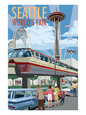
The World's Fair: The 1962 Seattle World's Fair, also called the Century 21 Exposition. After the fair, the exposition grounds were converted into today's Seattle Center. The Space Needle, the Monorail, the Fun Forest, and the Science Center all date back to the World's Fair.
We're dedicated to helping you find the exact poster or print you're looking for! If you can't find it here, and I'll see if I can hunt it down for you!
Contact:Bookmark this Site!
(IE or Firefox)