Seattle Lingo:
Food & Seafood
Look here for shorthand references and slang for Seattle-area and Northwest food and seafood, including salmon, steelhead, trout, clams, oysters, mussels, geoducks, crabs, and more.
- Blackmouth: I've read variously that this refers to an immature Chinook and to just a Chinook.
- Chinook: King of the salmon species, with the largest commercial catch weighing in at 125 lbs. and the largest sports catch at 97 lbs. Also commonly called a King or King Salmon. Other less common names are Spring Salmon (Canada) and Quinnat (Alaska native).
- Chum: Also called a Dog Salmon or a Keta (Alaska native).
- Clam Gun: There is some controversy over this. Old timers are liable to swear that the shovel with an elongated and slightly curved head that is used to dig razor clams was called a "clam gun." They're right. Sometime in the late 50s, however, a contraption in the shape of a cylindrical tube was introduced which made it easier for the less robust and more fastidious to also get their limits of the delectable bivalve. This contraption also came to be called a "clam gun," while the shovel used to dig razor clams gradually went back to just being called a "clam shovel." Needless to say, some old timers still refer to clam shovels as clam guns, however. By and large, those who swear by the shovel consider those who use that tube thing as cheaters, or at least as coming by something that is just too good (the razor clam) too easy. There is a bit of an art to using a razor clam shovel. The main idea is to dig your hole just to the surfside of the clam hole, so your shovel won't crush the clam's shell. You then kneel down and reach into the hole you've dug and, if you're lucky, you should be able to reach over and grab the clam by the back of its shell (the razor-sharp edges of a razor clam point inland, which is why you dig your hole to the surfside of the hole. Not much of an art to using one of those tube things, however -- just find a clam hole, shove the tube thing into the sand with the clam hole in the center, and then pull out the "plug" of sand. You then dump the tube's contents onto the beach and poke through it looking for your clam. Hardly sporting, in other words.
- Coho: Also commonly called a Silver Salmon.
- Copper River Salmon: Supposed to be the best of the best, a coho caught as part of the Copper River run. I'm not sure that this isn't mostly a marketing gimmick. You'll pay through the nose, that's for sure. Still, they've started to market salmon from other runs in the same way, as well, sort of like naming a wine after the region in France where the grapes were grown, I suppose. I suppose you could call it the Beaujolais of salmon, huh?
- Dog Salmon: See Chum.
- Dungies: Dungeness Crabs.
- Frangos: A mint confection that orginated at Seattle's Frederick & Nelson department store around the beginning of the 20th century and which was sold there until F&N closed in 1992. Frangos are still being manufactured, and have been sold through the Bon Marche, Bon-Macy's, and now Macy's in Seattle. The rights to Frangos went to Chicago's Marshall Fields department store in 1929, when Frederick & Nelson was purchased by them, although F&N continued to sell its own version of Frangos under license to Marshall Fields. People who are not from Seattle usually believe that Frangos originated in Chicago, but that is not true. The Marshall Fields recipe for Frangos has changed over the years, while the version sold through the Bon Marche is still made according to the original recipe. After Marshall Fields was bought by May Department Store Company in 2004, Macy's license to manufacture and market Frangos was not renewed, leading to a brief period during which Frangos were marketed as "Frederick & Nelson, the Original." In 2005, however, Federated Department Stores, Macy's parent company, bought May, allowing Macy's to begin marketing "Frangos" again. Macy's now sells the Northwest version of Frangos in the former Bon Marche stores, while the Midwest version is sold at Macy's department stores elsewhere in the nation. Northwesterners know which is the original, however, even if the rest of the country doesn't. If you're a Seattle ex-pat no longer in easy reach of one of the ex-Bon stores, to place an order for any of the original F&N Frangos varieties, just call 1-877-frangos.
- Geoduck: Pronounced "gooey duck." Not a duck, however, but king of the clams. A big mother of a clam. They are harvesting them in the Sound now, shipping off planeloads of them to Japan where they are considered a high delicacy. As long as they last, that is.
- Hatchery Brats: Hatchery salmon. They are generally smaller than wild salmon, and less tasty. They are also suspected of harming wild salmon runs.
- Humpy: See Pink.
- Jack: A one year-old Chinook salmon that has returned to spawn (they usually return after two years, I believe). The name is derived from the other name for a Chinook, a King. Not to be confused with the fish on the East Coast and in the Caribbean, also called a Jack, which is an entirely different fish.
- King: See Chinook.
- Kokanee: A land-locked Sockeye.
 Pike Place Market Cookbook: Recipes, Personalities, and Anecdotes from Seattle's Renowned Public Market by Braiden Rex-Johnson / Paperback / Published 1997. Price: $12.76 (20% discount) at Amazon.com. Pike Place Market Cookbook: Recipes, Personalities, and Anecdotes from Seattle's Renowned Public Market by Braiden Rex-Johnson / Paperback / Published 1997. Price: $12.76 (20% discount) at Amazon.com.
- Lutefisk: The national dish of Ballard and a constant running joke on Stan Boreson's old King's Klubhouse kid's show back in the 50's and 60's. Lutefisk is created by soaking air-dried whitefish, usually cod, in lye. For more info, see the Lutefisk entry at Wikipedia.
- Mapleine: An imitation maple flavoring often used to make homemade syrup, was invented in Seattle in 1905, by a chemist and salesman at Crescent Foods, which was founded in Seattle in 1883. Crescent Foods was bought by McCormack & Company ("McCormack Spices") in 1986, which still distributes "Crescent Mapleine," but only in limited quantities. Walmart supposedly carries it, if you can't find it anywhere else. To make Mapleine syrup, just heat one cup of water to a boil in a sauce pan, then add two cups of sugar and 1/2 teaspoon of Mapleine. Stir until the sugar is totally dissolved. Pour over pancakes, waffles, or french toast.
- Pink: The color "pink" refers to the lighter color of the meat. Also called a Humpy.
- Razor Clam: These are not the tender bi-valved morsels, butter clams, that you can dig up along Puget Sound, but quite chewy, but extremely tasty, leathernecks that inhabit the Washington coastline. You'll need your teeth to eat a razor clam. Best floured and fried. When I was a kid, after flouring and frying them, we always just squeezed some lemon on them and dunked them in universal condiment. These days, with razor clam digging seasons having shrunk to a sliver of what they used to be when I was a kid, the idea of dipping such a rare delicacy as a razor clam in ketchup (egad!) is more likely to inspire horror and disgust. I can only plead that at the time I, as just a boy from a pulp town (Aberdeen), was not exactly a sophisticated gastronome. Still, a razor clam has a strong and distinctive enough flavor to stand up to a foray into the occasional dollop of the red stuff, in my opinion. If you haven't tried it, don't knock it -- the squeamish can substitute cocktail sauce, if they wish.
The name, razor clam, by the way, comes from the fact that the shell of a razor clam can be very sharp. Many a digger has been cut, more than once. The trick to avoid getting cut is to always sink your shovel straight down on the water-side of the clamhole (about 4 or 5 inches away), then scoop the sand up in a kind of wedge shape, repeating two or three times. The point here is not only to dig on the water-side of the hole, but to avoid breaking the clam's shell with the shovel, which can also lead to cut fingers. If you're lucky, you should be able to reach in and grab the clam by its back--the razor edges are always pointed toward the land. If not, you may have to grope and feel around to find the clam, perhaps ending up, if the clam is particularly deep, in a tug-a-war that would test the strength of Hercules. One of the myths about razor clams is that they rapidly take off deeper into the sand once you've started digging. Not true, they actually move very slowly through the sand, although the faster the wetter the sand is. Actually, the wetter the sand, the closer the clam will be to the surface, which is why many diggers dig past the waterline.
- Red Salmon: See Sockeye.
- Silver: See Coho.
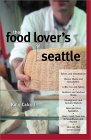 The Food Lover's Guide to Seattle by Kathy Calcott / Paperback / Published 2001. Price: $13.56 (20% discount) at Amazon.com. The Food Lover's Guide to Seattle by Kathy Calcott / Paperback / Published 2001. Price: $13.56 (20% discount) at Amazon.com.
- Silly Beans: Psilocybin mushrooms, more widely known as "magic mushrooms," or just "shrooms," which grow abundantly throughout the Northwest (and in Seattle), if you care to look for them (and know what to look for). I don't know if this is strictly a Northwest term, but I have heard it said here and have not been able to find a reference to it anywhere else.
The mushroom generally identified as the "psilocybin mushroom" is of the strophariacae psilocybe family and genus, containing well over 100 separate species, but 186 species of mushrooms in six different families are known to contain psilocybin. The most commonly found species in the Northwest is the psylocybe semilanceata, or "Liberty Cap." Do-it-yourself harvesters should be cautioned that look-alike mushrooms exist that are quite poisonous, even deadly. If you really want to hunt the wild shroom, join a mycological society first and take the time to become expert in identifying them. If you insist on trying them, do like Alice, and test them on yourself first, a small bite at a time, rather than feed them to your children. For those worried about such things, psilocybin is not generally tested for in drug tests, although it can be -- any traces in urine are usually eliminated within three days, which is probably one reason they don't usually bother to test for it. Possession and consumption is illegal in most places. While psilocybin spores had been widely available through the Internet or ads in publications such as High Times, the Feds have been cracking down on spore sellers by threatening to prosecute them for distribution of the full potential crop that might result to force them to cop to a lesser felony -- see PF's Encounter with the Law.
- Sockeye: Also called a Red Salmon (Alaska) or a Blueback (Columbia River).
- Steelhead: An ocean-going rainbow trout.
- Springers: Wild salmon that run in the spring (April to June).
For more info on Seattle and Northwest food and seafood, see A Seattle Directory.
The terms listed here range from the frequently to the seldomly used. Non-Nortwesterners should use these terms (in the vain hope of fitting in) only at the risk of being greeted by frequent blank stares. While some terms are known by virtually all Northwesterners, and actually spoken by many, others are known only to some or a few, while spoken by even fewer. However, if you hear one said, armed with this lexicon, you'll know what is meant.
Why Join the Art.com Affiliate Program
A Seattle Lexicon & A Seattle Directory: Your Guides to All Things Seattle
Contact:
© 2007-2011 by Steve Callihan
All Rights Reserved
|